The August Inflection Point: What Westpark's Full Opening Means for the West End of the County
The four-mile completion is a road. The second-order effects are a re-zoning of who lives where, who builds what, and which towns get pulled into Fort Bend's commuter shed next.

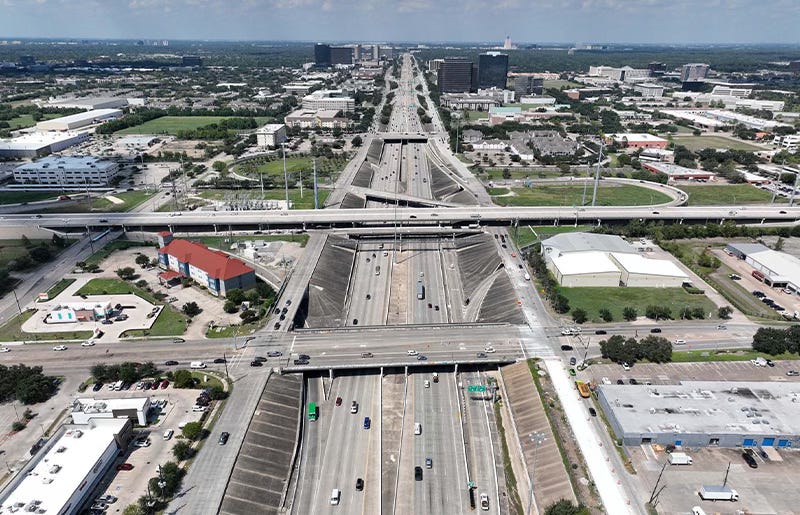
Photo of the Sam Houston Toll Road looking north from the Westpark Toll Road.
When the Fort Bend County Toll Road Authority cuts the ribbon on the final two miles of the Westpark Tollway extension this August, completing the four-mile push to Charger Way, most coverage will treat it as a transportation story. New pavement, fewer signals, shorter commutes. That framing is correct, and it is also far too small.
The first half of the extension — the segment from the old Spring Green terminus west to roughly the FM 1463 area — opened on February 28, nine months ahead of its contractual completion date. That early opening was the appetizer. August is the entrée, because August is when the tollway crosses an invisible line on the map: the line where Energy Corridor commute times for entire subdivisions drop below 25 minutes for the first time in the history of those neighborhoods.
That line, once crossed, doesn’t move back. And it changes four things at once.
I. The 25-Minute Line
Cross Creek Ranch, Tamarron, Cross Creek West, Fulbrook on Fulshear Creek, and Weston Lakes have all been technically reachable from the Energy Corridor for years. Reachable, however, is not the same as commutable. A 35-minute drive at 6:30 a.m. is a job-search radius. A 25-minute drive is a relocation decision.
The Energy Corridor sits less than 25 miles from west Fulshear, but the door-to-door clock has always been governed by the last few miles — the FM 1093 / Spring Green bottleneck and the surface-street stretch through old Fulshear. The four-mile extension to Charger Way replaces the worst of that with continuous tolled main lanes and grade-separated overpasses at Texas Heritage Parkway, Cross Creek Ranch Boulevard, and FM 1463. That is not a marginal improvement; that is the elimination of the slowest links in the chain.
The neighborhoods that benefit most are the ones whose front gates feed into Texas Heritage Parkway, FM 1463 south of Spring Green, or the Charger Way corridor itself. For the first time, a buyer touring a new build at Cross Creek West or the platting expansions at Fulbrook can do the math at the kitchen table and reach a single-digit number of minutes between their driveway and the tollway on-ramp — and, depending on traffic and final destination, a low-to-mid-20s door-to-door figure to Energy Corridor employers along Westheimer Parkway. Weston Lakes sits a touch further west and won’t see sub-25 figures until Phase III pushes the tollway out toward Simonton; for now, our improvement is more modest, measured in the disappearance of the FM 1093 stop-and-go rather than the addition of new through-capacity.
The practical effect: the addressable buyer pool for west-of-Heritage Parkway homes just expanded from “people willing to commute 35–45 minutes” to “people willing to commute 22–28 minutes.” That is a different demographic, with different incomes, different employers, and different expectations of what the local commercial landscape should look like.
II. The Numbers the FBCTRA Hasn’t Told Us
It is worth being honest about a gap in the public record. The Fort Bend County Toll Road Authority (FBCTRA) has published the project cost — roughly $72 million — and confirmed the contractor (Harper Brothers Construction), the alignment, and the milestone schedule. What has not been published, as far as I have been able to find, is an extension-specific traffic projection: a forecast of expected daily transactions on the new four-mile segment in year one, year five, and year ten.
What we do have is a baseline. The existing Westpark Tollway grew from 54.9 million to 64.9 million annual transactions between 2019 and 2023 — a compound annual growth rate of about 1.8 percent across the whole system. That number, however, was generated by a corridor that ended at Spring Green with a hostile pinch point at the western end. A westward extension that eliminates the pinch point and adds direct access for tens of thousands of new rooftops between Texas Heritage Parkway and Charger Way will not grow at 1.8 percent. It will likely jump.
How big a jump? That is exactly the question FBCTRA’s traffic and revenue consultants have answered internally — bond covenants require it — but the public-facing version of those projections has not, to my reading, made it onto the Authority’s website. For a project that is reshaping the residential and commercial geography of an entire end of Fort Bend County, the absence is notable. If any reader has a copy of the most recent Traffic & Revenue (T&R) study, I’d welcome the citation.
III. The Politics of Phase III
The August opening also rewrites the politics of the next phase, the one that has been hovering in the background for two years: extending the tollway from Charger Way west toward FM 1489 in Simonton, with Wallis on a longer horizon. Precinct 1 Commissioner Vincent Morales has publicly championed the Simonton extension, and FBCTRA has identified it as a future Phase III. Initial planning began in 2025.
Until August, Phase III was an aspirational line item in the capital plan. After August, it becomes something harder to push back against, because the four-mile extension will create a textbook traffic-engineering problem at its own western end: a high-capacity tolled facility that dumps four lanes of moving vehicles into a two-lane FM 1093 west of Charger Way. That is the exact failure mode the original tollway suffered at Spring Green for a decade, and it is the political argument that built the case for Phase II.
So the calculus shifts. Opponents of further westward extension — and there are real ones, including residents who moved to Simonton and Wallis precisely because the freeway didn’t reach them — will now be arguing against a project whose justification is congestion that the previous phase created. That is a much harder argument to win before Commissioners Court than the abstract argument they were making twelve months ago. My read: Phase III moves from “if” to “when” in political consciousness within the first six months after the August opening, even though shovels-in-the-ground are still years away.
IV. The FM 1093 Paradox
Now the genuinely contested question: does a fast lane parallel to FM 1093 kill the FM 1093 commercial buildout, or accelerate it?
The intuitive case for “kill” is straightforward. Drivers who would have crawled past Fulshear Central, Founders Hill, and Texas Heritage Marketplace at 25 mph are now flying past them at 65 on the elevated lanes, with no exit incentive to slow down and shop. Retail leasing agents have lost sleep over less.
The case for “accelerate” is more interesting and, I think, correct. The buildout currently underway is not pinning its bet on impulse drive-by traffic. Fulshear Central — 22 acres, 130,000 square feet, with the first five office buildings scheduled to open in late 2026 — is sized for a captive west-side population. Founders Hill, a 33-acre site at 30200 FM 1093 with first-phase tenants targeted for year-end 2026, is the same bet on a larger scale. And Texas Heritage Marketplace, with its 149,000-square-foot Target and a Sam’s Club whose construction begins August 3 and ends December 7, is anchored to a regional grocery-and-club draw that pulls from a 15-minute radius regardless of the through-traffic mix.
What the tollway does is enlarge that 15-minute radius — pulling Pecan Grove, parts of Richmond, and eventually Simonton residents into shopping orbits that were previously someone else’s. The fast lane, in other words, is not a substitute for the FM 1093 commercial corridor. It is the trade route that feeds it. Expect leasing announcements to accelerate, not pause, in the four quarters following the August opening.
V. The FM 1463 Counterweight
None of this happens in isolation. The Westpark extension is the headline, but the slower-burn corridor story is happening on FM 1463, where TxDOT’s $108 million, 6.7-mile widening — two lanes to six north of Spring Green, two to four with raised medians south of it — is finally entering its mid-2026 finishing milestones.
By mid-2026, TxDOT projects permanent intersection signals, sidewalks, crosswalks, and landscaping in place along the new right-of-way. Substantial completion is targeted for the fourth quarter of 2026, with full administrative closeout in June 2027. The project began in February 2022, which means the residents who have endured five years of construction get their reward in roughly the same window as the Westpark opening.
The two projects, taken together, finish the puzzle that has been driving residents on this side of the county to the brink for a half-decade. Westpark gives the corridor a fast east-west spine. FM 1463 gives it the high-volume north-south arterial that connects the spine to I-10. Without both, neither works. With both, the residential build-out west of Heritage Parkway has the road network it has been missing.
What to Watch Through Autumn
Three things are worth tracking in the months bracketing the August opening. First, FBCTRA’s tolling and transaction data — even partial monthly counts will tell us whether the use-case is replacing FM 1093 trips or generating new ones. Second, leasing announcements at Fulshear Central, Founders Hill, and the Texas Heritage Marketplace pads, particularly the second-tier slots that surround the anchors. And third, any movement in Commissioners Court on Phase III planning dollars; that is the leading indicator that the political conversation has shifted.
The corridor is reshaping under our feet. August is the moment it becomes irreversible.
Bob Gordon publishes About Fulshear, Texas. He lives in Weston Lakes, serves as Director of Development for the Fulshear Historical Association, and is on the Board of the Fort Bend History Association.
Sources
Westpark Tollway Extension Opens First Segment Saturday in Fulshear — Covering Katy News
2-mile stretch of Westpark Tollway extension to open ahead of schedule — Community Impact
Westpark Tollway Extension Opens Early in Fulshear — My Neighborhood News
Morales Planning Expansion of Westpark Tollway to Simonton — Covering Katy News
Project pains: 5-year FM 1463 widening frustrates Katy, Fulshear community — Community Impact
Fulshear Central Set to Revolutionize Lifestyle and Convenience — My Neighborhood News
Fulshear Central Development Begins Construction — Covering Katy News
Target anchored Texas Heritage Marketplace continues growing — Covering Katy News


With the limited number of homes on the current U.S. market, you need an agent with the right connections, technology, and strategies to achieve your home-buying or selling vision. Whether you’re feeling overwhelmed and want someone to take the wheel, or you just need a second opinion and you have it covered, you can be rest assured a RE/MAX agent is the right agent for any level of service, in any market condition. Visit Tajana Surlan’s website here to learn more. Surlan’s phone number is (972) 415-3017 (cell) or (713) 636-3015 (office).
Want to see your business here? Contact us at sponsors@aboutfulsheartexas.org for sponsorship opportunities.
Supporting Our Local History. All proceeds from “About Fulshear, Texas” sponsorships go directly to the Fulshear Historical Association, a registered 501(c)(3) nonprofit dedicated to preserving and celebrating the rich heritage of our community.
About Fulshear, Texas, is the area’s authoritative hyper-local media ecosystem. Our Substack newsletter achieves a 60%+ open rate, our Facebook presence (@About Fulshear Texas) generates over 35,000 monthly views, and we have launched a community podcast. We reach more than 8,000 unique individuals monthly, with 53.5% residing directly in Fulshear. The core demographic is affluent homeowners aged 35 to 54—representing peak household earning years, established homeownership, and the population most likely to refinance, purchase investment properties, or refer neighbors and colleagues to a trusted lender.