
Transforming a rapidly growing small town into a self-sustaining city requires a complex transition from a “rooftops first” residential area into an independent economic engine. Given Fulshear’s ongoing transformation, the municipality must strategically manage its infrastructure, commercial development, urban planning, and financial tools to successfully navigate hyper-growth.
Here is how a small town becomes a self-sustaining city:
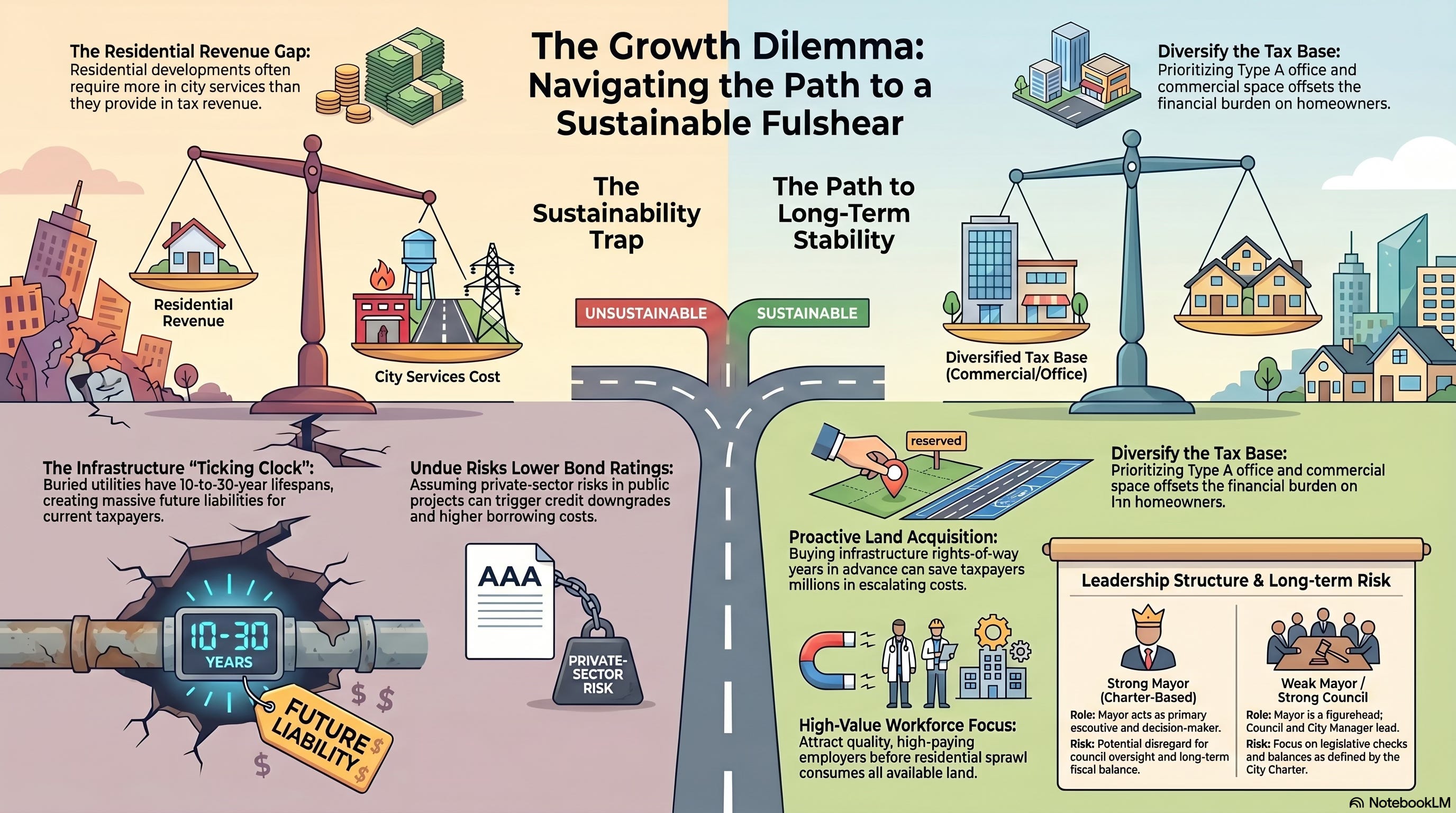
1. Diversifying the Tax Base and Capturing “Retail Leakage” A city cannot sustain itself on residential property taxes alone. Residential developments often act as a draw on a city’s resources because they require more services (roads, sewer lines, utility maintenance) than they contribute in tax revenue. To survive, a growing town must mature its commercial sector to diversify its tax base. This involves capturing “retail leakage”—the phenomenon where residents take their purchasing power to neighboring municipalities because their own town lacks local services, dining, and retail. By developing major commercial centers and mixed-use destinations (such as Fulshear Gateway and Founder’s Hill), the city generates essential sales tax revenue to fund municipal services like police and fire without overburdening homeowners.
2. Scaling Foundational Infrastructure Rapid residential saturation quickly taxes a small town’s existing utility capacity. To become self-sustaining, the city must pre-plan and aggressively fund massive infrastructural upgrades. This includes:
Water and Wastewater Capacity: Implementing comprehensive master plans to handle exploding demand. For example, Fulshear is investing over $100 million in local receiving infrastructure to prepare for a 440% increase in water demand and to convert its systems to meet state-mandated surface water requirements.
Regional Roadways: Small towns must prioritize transportation logistics, using thoroughfare plans and pavement condition evaluations to upgrade rural roads into commercial corridors capable of safely handling high traffic volumes.
3. Implementing Strategic Urban Planning and “Placemaking” To welcome large-scale growth while maintaining its original appeal, a town must implement sophisticated urban design. This transition involves moving away from isolated retail strip malls toward integrated, mixed-use nodes that prioritize community gathering and “placemaking”. Key urban planning steps include:
Walkability: Enhancing downtown districts with continuous sidewalk networks, pedestrian-friendly intersections, and green spaces.
Traffic Restructuring: Implementing creative traffic solutions, such as converting main thoroughfares into one-way couplet systems, which alleviates congestion while positioning commercial developments favorably for commuters.
Zoning and Design Standards: Establishing overlay zoning districts to regulate building setbacks, landscaping, and architectural styles, ensuring that new developments reflect the town’s historical character.
4. Leveraging Economic Development Financing Tools: Building the infrastructure for a major city is incredibly expensive. A self-sustaining city relies on a framework of statutory tools to incentivize development and fund public improvements without bankrupting the municipality. Essential tools include:
Economic Development Corporations (EDCs): Utilizing Type A and Type B EDCs, funded by local sales taxes, to administer grants and attract high-quality commercial projects and primary employers.
Public Improvement Districts (PIDs) & TIRZs: Levying targeted property assessments within specific districts to fund localized infrastructure upgrades, such as downtown sidewalks or drainage systems, offsetting the massive upfront costs for developers.
5. Prioritizing Long-Term Governance. Finally, a self-sustaining city requires leadership with a long-term vision. Once infrastructure is buried in the ground, a “ticking clock” begins on its lifespan. Leaders must establish sustainable funding paths for future maintenance rather than making convenient, short-sighted deals to attract initial builders, which can eventually leave the city to crumble when early revenues plateau. A self-sustaining model requires officials to balance the complex interplay of rapid urbanization, regulatory compliance, and community preservation so that the city remains viable for generations.

Daisy is committed to providing top-tier home automation sales, services, and solutions to our local area. We are proud to support the Fulshear community and help share its unique stories. Visit us at https://daisyco.com/katy-tx/ to learn more. Daisy’s phone number is (281) 822-3339.
Want to see your business here? Contact us at sponsors@aboutfulsheartexas.org for sponsorship opportunities.
Supporting Our Local History. All proceeds from “About Fulshear, Texas” sponsorships go directly to the Fulshear Historical Association, a registered 501(c)(3) nonprofit dedicated to preserving and celebrating the rich heritage of our community.
About Fulshear, Texas, is the area’s authoritative hyper-local media ecosystem. Our Substack newsletter achieves a 60%+ open rate, our Facebook presence (@About Fulshear Texas) generates over 35,000 monthly views, and we have launched a community podcast. We reach more than 8,000 unique individuals monthly, with 53.5% residing directly in Fulshear. The core demographic is affluent homeowners aged 35 to 54—representing peak household earning years, established homeownership, and the population most likely to refinance, purchase investment properties, or refer neighbors and colleagues to a trusted lender.


