Heritage Bend: Eight Builders, One Developer, One Financial Sponsor
The 7,000-home Hines community taking shape at FM 1093 and Texas Heritage Parkway is the clearest local example yet of how master-planned dirt now gets financed, built, and sold.

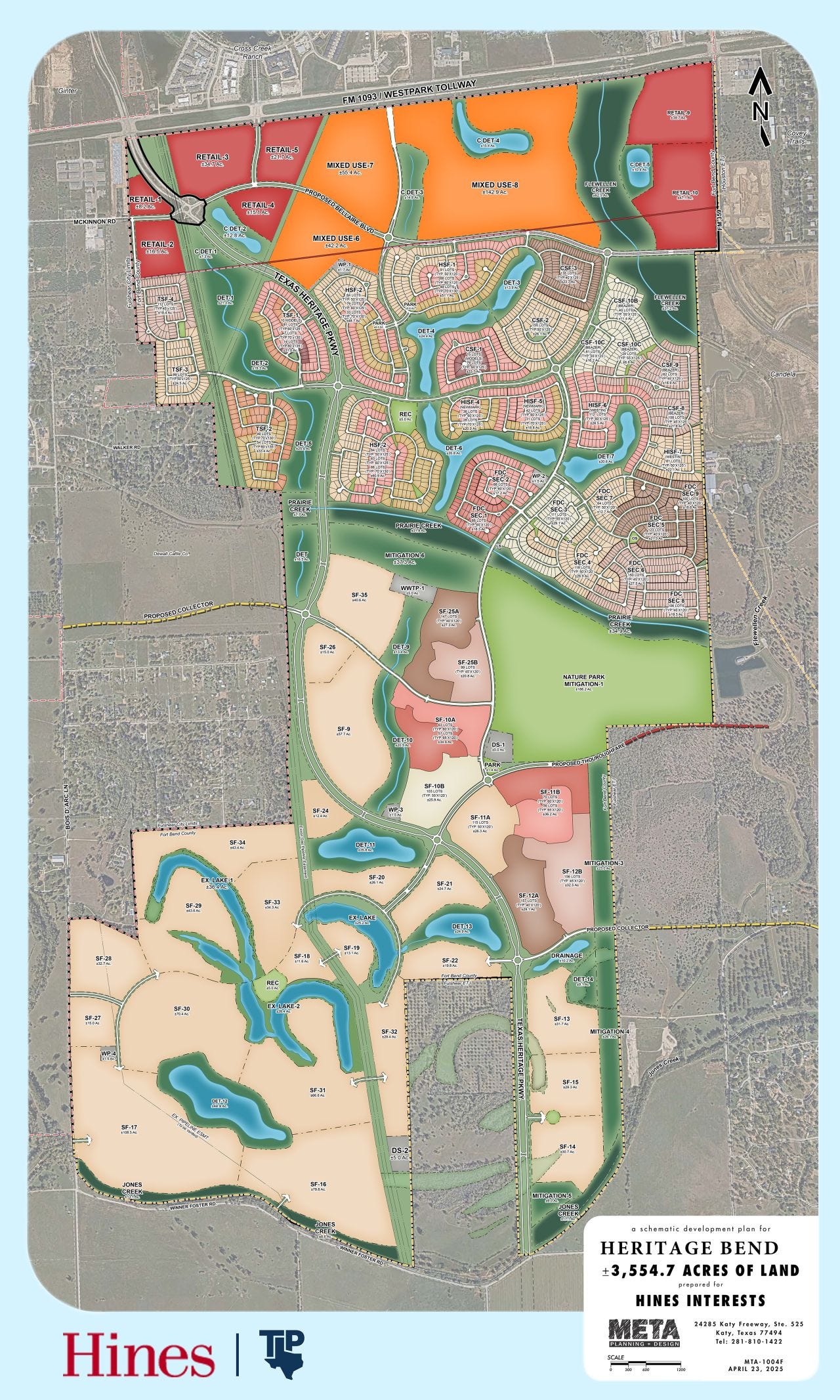
When Hines announced in January 2025 that it had assembled nearly 3,000 acres at the intersection of FM 1093 — the continuation of the Westpark Tollway west of the Grand Parkway — and Texas Heritage Parkway, the headline number rightly drew most of the attention: more than 7,000 homes on 2,951 acres in unincorporated Fort Bend County, just south of Cross Creek Ranch. At full build-out, Heritage Bend will roughly double the rooftops already in our immediate corridor. First finished lots are scheduled to be delivered in 2027.
Sixteen months later, the project has a name — Heritage Bend — and a closed $129.2 million Municipal Utility District bond to pay for its first wave of roads, water, and sewer. (I wrote about that bond in an earlier post in this series, including who is on the hook to repay it.) What’s worth pausing on now is not the bond, the acreage, or even the home count. It is the structure of the deal — and what that structure says about how the land under us is being financed.
Eight builders, one developer
Hines named eight builder partners the day it announced the community: Toll Brothers, Perry Homes, Highland Homes, Village Builders/Lennar, Dream Finders Homes/Coventry Homes, Westin Homes, Newmark Homes, and Beazer Homes. Three of those — Toll Brothers, Lennar, and Beazer — are publicly traded national builders; the others are large regional operators. Together, they cover the full price spectrum a Houston-area master plan needs to fill, from entry-level to semi-custom.
None of those eight, however, owns the dirt. Hines does. And Hines is not, in the way most residents still picture a “developer,” a Texas builder that has spent the last forty years buying ranches and selling lots. Hines is a global real estate investment manager with roughly $93 billion in assets under management, 5,000 employees, and offices in 31 countries. It develops on behalf of institutional clients — pension funds, sovereign wealth funds, insurance companies, family offices — who want exposure to U.S. single-family land without having to swing a hammer.
That is the shift this series has been tracking. A generation ago, the typical Fulshear-area subdivision was platted and sold by a Texas-based developer who personally knew the rancher he was buying from. Today, the planning is being done by a fund manager with a fiduciary duty to investors halfway around the world. The dirt has been turned into a financial product, and institutional check writers are the new owners. Heritage Bend is the clearest, largest, and closest example we have.
How the money actually moves
The capital stack at Heritage Bend, simplified, has three layers.
At the top sits the financial sponsor — the Hines fund or co-investment vehicle that put up the equity to acquire the 2,951 acres. Hines does not publicly disclose the specific vehicle or its investor list, but its land-development business has historically been funded by separately managed accounts and commingled funds backed by institutional capital. Those investors expect a return measured in years, not decades, which is one reason master plans now race to first-lot delivery.
In the middle sits the developer — Hines acting in its operational capacity, the entity that hires civil engineers, contracts the horizontal work (earthwork, drainage, roads, utilities), and signs lot-takedown agreements with builders. The $129.2 million MUD bond is the public debt slug of this layer; future homeowners within the MUD will repay it through their property tax bills.
At the bottom sit the builders — the eight names above. In the standard model, they don’t buy finished lots until they’re ready to start vertical construction, typically in defined “takedown schedules” of 25 to 100 lots at a time. That arrangement is attractive to publicly traded builders because it keeps undeveloped land off their balance sheets, which is what Wall Street rewards. The trade-off is a markup: the developer captures the spread between raw-acre cost and finished-lot price.
Highland’s twist
There is one interesting departure from the standard model worth flagging. Houston Agent Magazine reported in May 2025 that Highland Homes will self-develop roughly 188 acres of Heritage Bend, accommodating about 620 homes. Highland is handling its own horizontal work — lot development, roads, water, utilities — rather than buying finished lots from Hines.
Highland’s senior vice president of land, Jeff Stinson, told the magazine the company is “pursuing more opportunities across the state” along these lines. In other words, at least one builder has decided it would rather capture some of the dirt economics itself than cede them entirely to the fund manager. Whether that becomes a trend across other Houston-area master plans is one of the more interesting questions to watch over the next two years.
Why Heritage Bend matters locally
The civic story at Heritage Bend is the familiar one: 7,000 households imply roughly 14,000 vehicles, an unknown number of new students for Lamar CISD (which is already planning for more than 19,600 additional students over the next decade), and added load on FM 1093, Texas Heritage Parkway, and any future east-west extension of Bellaire Boulevard. Hines has agreed to extend Texas Heritage Parkway from FM 1093 to Winner-Foster Road, and a Bellaire extension through the property is under consideration.
The financial story is the one I keep coming back to. A 2,951-acre tract that was, within most of our lifetimes, ranch and rice land has been transformed into a structured investment product: institutional equity at the top, MUD bonds in the middle, eight builder offtake agreements at the bottom, and a 2027 first-lot delivery date driving the whole machine forward. That is what the financialization of dirt looks like when it lands in your zip code.
The construction trucks will be the visible part. The capital stack, which determines what gets built and how fast, will mostly remain invisible. The aim of this series is to keep the invisible part in view.
Sources
Kendall Jackson, “7,000 Homes Coming to Fulshear Area,” Covering Katy News, January 26, 2025.
Emily Marek, “Highland Homes to develop community in Fulshear,” Houston Agent Magazine, May 1, 2025.
Aubrey Vogel, “Hines to debut 3K-acre master-planned community near Fulshear,” Community Impact, January 23, 2025.
Premium Houston Homes LLC
Owned by Kent Harris, Premium Houston Homes LLC is a Fulshear-based real estate investment firm that specializes in purchasing, renovating, and renting distressed properties, and provides traditional buying and selling services, with a focus on homeowners navigating difficult life transitions. You can reach the company at (832) 578-1967 or learn more on their website at premiumhoustonhomes.com.
Want to see your business here? Contact us at sponsors@aboutfulsheartexas.org for sponsorship opportunities.
Supporting Our Local History. All proceeds from “About Fulshear, Texas” sponsorships go directly to the Fulshear Historical Association, a registered 501(c)(3) nonprofit dedicated to preserving and celebrating the rich heritage of our community.
About Fulshear, Texas, is the area’s authoritative hyper-local media ecosystem, reaching over 8,000 unique individuals monthly (53.5% of whom reside directly in Fulshear). Our platform commands deep community attention: our Substack newsletter achieves an exceptional 60%+ open rate, our Facebook presence (@About Fulshear Texas) generates over 35,000 monthly views, and our reach continues to expand with our new community podcast.
Our core audience consists of affluent homeowners aged 35 to 54. Because they represent peak household-earning years and established homeownership, partnering with us connects your brand directly with a high-intent demographic with strong purchasing power and deep community ties.
Interesting story on the investment vehicles.