Engineering a Wild Creek: How Cross Creek Ranch Brought Its Waters Back to Life
The ponds, lakes, and creeks that define Fulshear's largest master-planned community didn't happen by accident.

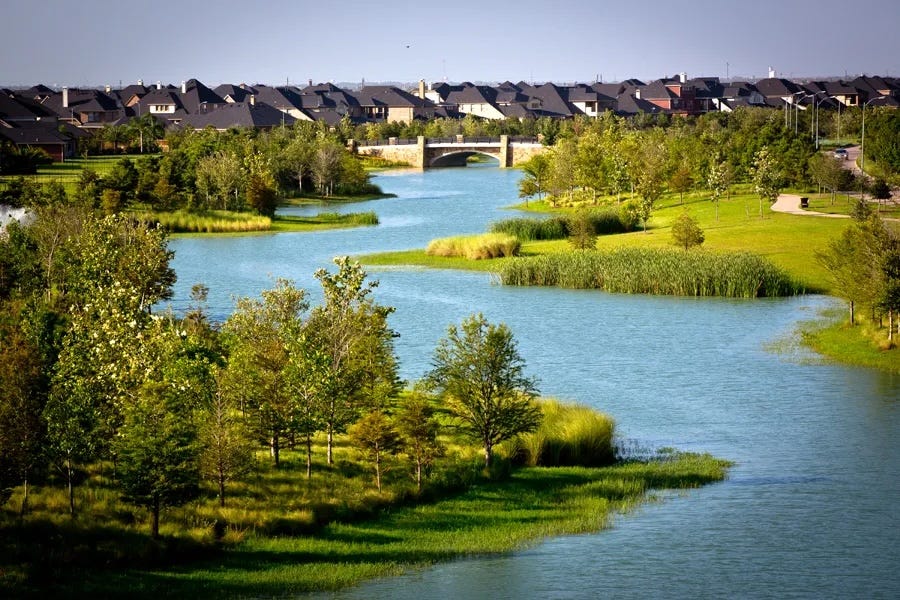
The ponds, lakes, and creeks that define Fulshear’s largest master-planned community didn’t happen by accident. They are the product of a two-decade collaboration between landscape architects, ecologists, and engineers who set out to rebuild an ecosystem that ranching had nearly erased.
Anyone who has walked the boardwalks along Flewellen Creek at sunset, watched egrets stalk the shallows of the Polishing Pond, or fished from a dock on one of Cross Creek Ranch’s lakes might assume these waters have always been here. In a sense, they have — and in a more important sense, they very much have not.
When Trendmaker Development Company purchased the 3,200-acre ranch property in 2005, the land told a harder story. Two centuries of farming and cattle grazing had taken their toll. Flewellen Creek, the waterway that gives the community its name and its spine, had been straightened into an agricultural drainage ditch decades earlier — its natural curves erased in the name of efficiency. Sediment had filled the channel. The creek was cut off from its floodplain, badly eroded, and, in the words of the ecologists who later studied it, “a virtually lifeless irrigation ditch.” Matt Baumgarten, the SWA Group landscape architect who led the restoration planning, put it bluntly: “The property was denuded by ranching. The site was hurting. It has really been degraded.”
What happened next made Cross Creek Ranch a national case study in how a residential developer can put a landscape back together rather than pave over what remains.
The Team Behind the Water
Three firms, working across two developers, deserve the credit residents enjoy today.
SWA Group, the internationally known landscape architecture and planning firm with a longstanding Houston studio, served as master landscape architect and planner for the full 3,200 acres — roughly 960 acres of which were devoted to landscape and open space. Baumgarten led the restoration planning, guided by a philosophy of biomimicry: rather than imposing a conventional suburban template of clipped lawns and concrete-lined detention ponds, SWA asked what this stretch of the Texas coastal prairie looked like and how it functioned before it was ditched and grazed — and then designed the community’s water systems to work the same way.
Biohabitats, a nationally respected ecological restoration firm, brought the stream science. Their specialists in fluvial geomorphology — the study of how flowing water naturally shapes channels and floodplains — designed the rebuilt creek so that its meanders, pools, and floodplain connections would be self-sustaining rather than ornamental.
Brown & Gay Engineers (today known as BGE), the Houston-based civil engineering firm, made the hydrology and drainage work, ensuring that a creek designed to look and behave wild could still do the hard municipal job of moving stormwater safely through a community of thousands of homes.
Work began in 2005 under Trendmaker, and when Johnson Development Corporation acquired the remaining property in the spring of 2012, it kept the team — and the vision — in place. The restoration proceeded in three major phases over fifteen years, with the final stretch completed in November 2020.
Un-Straightening a Creek
The heart of the project was undoing what a bulldozer had done generations before. The design team took what SWA describes as a “derelict 130-acre ranching ditch” and rebuilt it into a living, three-mile-long creek ecosystem — reintroducing meanders that roughly doubled the channel’s length. Those curves aren’t decorative. A meandering channel slows water, reduces erosion, creates alternating deep pools and shallow runs that fish and aquatic insects need, and gives the creek room to breathe during floods.
Just as important, the designers reconnected the creek to a 450- to 600-foot-wide floodplain corridor. Instead of forcing high water through a narrow channel — the approach that fails so catastrophically across the Houston region — Flewellen Creek was given a broad, naturally vegetated valley to spread into when storms arrive. The final phase alone reconnected roughly 15,000 linear feet of stream to its floodplain and added oxbow wetlands and riparian habitat within a 260-acre park corridor.
The banks were then replanted the way nature would have done it: native grasses and black willows along the water’s edge, riparian forest in the corridor, prairie meadow beyond, and water-cleansing wetlands at strategic low points. Invasive species were removed and replaced with indigenous vegetation suited to the Katy-Fulshear prairie — a fitting gesture in a region where less than one percent of the original Texas coastal prairie survives.
Lakes That Work for a Living
The community’s more than 400 acres of lakes and waterways follow the same logic: every scenic water feature is also functional infrastructure.
The most remarkable example is the 50-acre Polishing Pond, a constructed wetland and water-treatment system planted with reeds and native grasses. Stormwater runoff from streets and lawns flows into this system, where wetland plants and their root-zone microbes filter out sediment, fertilizer residue, and other pollutants — exactly the cleansing service natural prairie wetlands performed here for millennia. The “polished” water is then recycled to irrigate the community’s parks and common areas rather than being drawn from drinking-water supplies. SWA’s project accounting credits the system and the surrounding naturalized landscape with saving about 4 million gallons of potable water annually, alongside an 81-ton yearly reduction in fertilizer use and a 65 percent decrease in mowing expenses compared to conventional landscape maintenance.
The Proof: Wildlife Came Back, and the Homes Stayed Dry
Ecologists like to say a restoration isn’t finished until the wildlife votes with its feet — or fins. By that measure, Flewellen Creek passed. Native fish, turtles, migratory birds, and raptors have returned to a waterway that supported almost nothing twenty years ago. In February 2014, the Houston-Galveston Area Council recognized the project with its Parks and Natural Areas award, and the restoration’s reputation spread: a neighboring developer along the creek later brought in the same restoration team to naturalize additional reaches of Flewellen Creek beyond Cross Creek Ranch’s borders.
Then came the sterner test. When Hurricane Harvey stalled over the region in August 2017 and dropped historic rainfall, that 450-to-600-foot floodplain corridor did precisely what fluvial geomorphology said it would: it absorbed the flood and protected the adjacent homes. It is no small thing that roughly 42 percent of Cross Creek Ranch residents live directly adjacent to the re-naturalized creek corridor — in most Houston-area communities, living next to the drainage way is a liability; here it is the premium lot.
Rob Bamford, Cross Creek Ranch’s general manager, summed up the underlying commitment in 2022: “At a minimum, 20% of our land ends up with open space, parks, trails and detention lakes.” That standard now carries over into Cross Creek West, where the nature-first water system continues along the upper reaches of Flewellen Creek.
So the next time you cross a boardwalk over the creek or watch your kids cast a line at the Polishing Pond, take a moment to appreciate the paradox beneath your feet: it took some of the country’s best landscape architects, ecologists, and engineers — SWA Group, Biohabitats, and Brown & Gay — nearly two decades of deliberate work to make Fulshear’s waters look like no one ever touched them at all.
Sources: SWA Group project profile; CultureMap Houston (June 2012); Biohabitats newsletters (2014, 2015); Community Impact (December 2022); Cross Creek Ranch community website.

We are grateful to welcome the Peschke Wealth Management Group of Raymond James to our team of sponsors. Peschke Wealth Management takes a team approach to financial planning, providing a broader scope of experience than you will likely find in any one person. Clients are our main priority, which is why we work to understand your unique circumstances and ultimately create a distinctive plan that provides a roadmap for your financial journey.
Supporting Our Local History. All proceeds from “About Fulshear, Texas” sponsorships go directly to the Fulshear Historical Association, a registered 501(c)(3) nonprofit dedicated to preserving and celebrating the rich heritage of our community.
About Fulshear, Texas, is the area’s authoritative hyper-local media ecosystem. Our Substack newsletter achieves a 60%+ open rate, our Facebook presence (@About Fulshear Texas) generates over 35,000 monthly views, and we have launched a community podcast. We reach more than 8,000 unique individuals monthly, with 53.5% residing directly in Fulshear. The core demographic is affluent homeowners aged 35 to 54—representing peak household earning years, established homeownership, and the population most likely to refinance, purchase investment properties, or refer neighbors and colleagues to a trusted lender.