A Second Vote on Firethorne, a First Look at Next Year's Budget: Your Guide to the Fulshear July 21 Council Meeting

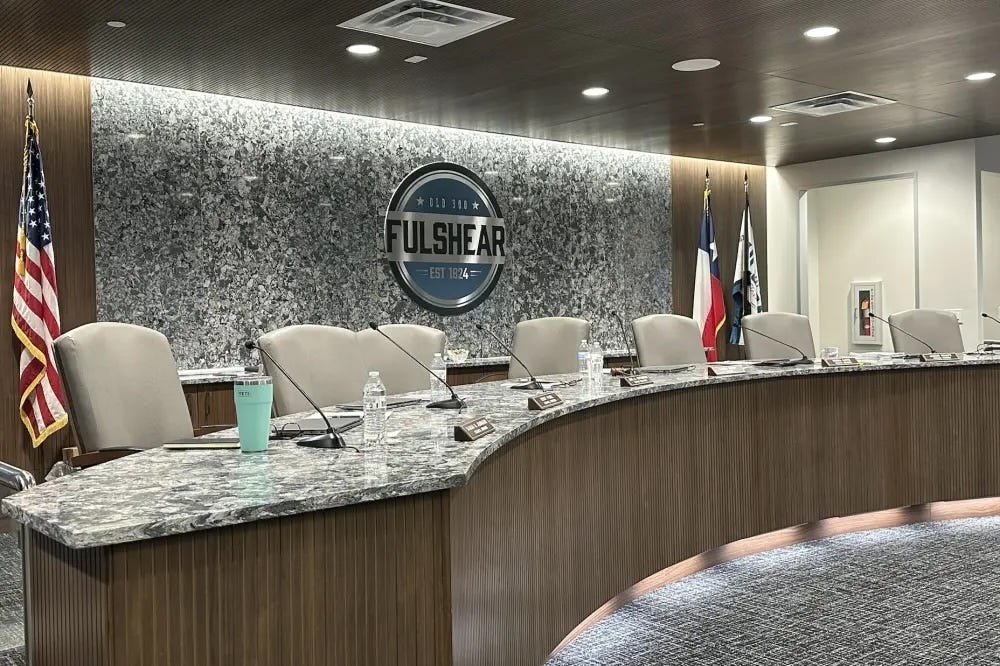
City Council meets Tuesday at 6 p.m. with a 362-page agenda packet that includes a do-over on a development vote it rejected last month, the first full discussion of the FY2027 budget, and a decision point on e-scooters. Here’s what’s on the table and why it matters.
The agenda packet for Tuesday’s City Council meeting runs 362 pages. Most residents will never open it — that’s what I’m here for. But this one rewards attention, because buried in those pages are three things that will shape Fulshear in ways you’ll actually feel: next year’s budget (and the tax rate math behind it), a rare second vote on a development deal council rejected 5-2 just five weeks ago, and the question of whether the city’s e-scooter experiment in education-over-enforcement has worked.
Council meets Tuesday, July 21, at 6:00 p.m. at the Fulshear Municipal Complex, 6611 W. Cross Creek Bend Lane. Here’s the guide.
The Firethorne deal is back — five weeks after council said no
On June 16, council voted 5-2 against consenting to the annexation of roughly 11.9 acres of land into Fort Bend County MUD No. 151 — the utility district that serves Firethorne. On Tuesday, at the request of the prospective developers, the same package is back: three linked items covering a development agreement supplement, an expansion of the city’s extraterritorial jurisdiction, and the MUD annexation consent itself.
Some background, because the mechanics matter here. The land sits at Cane Island Parkway and FM 1463, across the highway from Firethorne, and it’s slated for commercial and multi-family development. It used to sit in the City of Houston’s extraterritorial jurisdiction — the buffer zone around a city where it has limited authority — and the owners petitioned out. Now they’ve petitioned into Fulshear’s ETJ and into MUD 151, whose resident directors have requested annexation because it would bring the project’s tax base into their district.
If your instinct is to read “multi-family” and reach for the no button, it’s worth being clear about what a no vote actually does. Rejecting the deal doesn’t stop the development — it decides whose rules apply when it happens. The property owners control whether something gets built there. What council controls is whether it happens inside Fulshear’s orbit, subject to a development agreement, or outside it, subject to almost nothing.
And the agreement on the table does extract real commitments: the developers would follow city building codes, pay per-unit fees into the regional park program, submit to the city’s multi-family inspection regime (with an annual fee), and dedicate land along Cane Island Parkway that the city could use for future road widening — or, the packet notes, a “Welcome to Fulshear” sign.
Why it failed 5-2 in June, the packet doesn’t say. Whether five weeks and a developer request are enough to change five minds is the most interesting open question of the night.
The FY2027 budget: a surplus, a COLA, and a tax rate footnote worth reading
The headline numbers in the preliminary budget are healthy. The general fund projects $21.2 million in revenues against $20.8 million in operating expenditures — a $374,000 surplus — with an ending fund balance of roughly $7.8 million, or 38% of operating costs. The city’s own policy target is 25%. By that measure, Fulshear is sitting comfortably.
A few things inside the numbers deserve your attention.
Police are the biggest driver of spending growth. The police budget rises about $978,000 — nearly 17% — over this year’s projection. That buys market salary adjustments to bring officers to at least 55% of market pay, three new sworn officers, and about $295,000 in vehicles and equipment. Much of this is funded by the sales tax reallocation voters approved, which shifts roughly $1.2 million a year from the Type A economic development corporation to the general fund — about $800,000 of it earmarked for police compensation.
All city staff would get a 4% cost-of-living adjustment. After three straight years of 2% COLAs, staff argues Fulshear has fallen behind peer cities (whose adjustments range from 3% to 4.25%), and the retention numbers back the concern: turnover hit 25% in FY2025 before recovering to 14% this year. The 4% COLA is estimated to cost $318,000.
The tax rate footnote. The budget assumes the current tax rate for planning purposes. But with the parks bond issuance, the debt-service side of the rate is projected to rise from $0.051 to $0.069 per $100 of value, while the operations side — currently $0.117 — “would likely compress slightly.” Translation: the total rate could tick up, and the real decision comes in August and September, after the certified tax roll is released. That’s when the public hearings happen. Mark it.
There’s also a capital program worth $20.2 million citywide next year — more than half of it the $10.5 million Primrose Park build-out — and a “bullpen” of unfunded projects council could advance using the roughly $2.26 million in fund balance sitting above the 25% target. Utility customers, take note: the budget assumes no water rate increase, helped by a legal determination that impact fees paid by new development can cover debt on growth-related projects.
Alongside the budget discussion, council will also take up an update to the master fee schedule — the citywide price list for permits, applications, and services. The packet includes no backup on it, so watch the meeting for the details.
E-scooters: one citation later, what now?
In October 2025, council adopted an ordinance regulating e-scooters and similar vehicles, with fines up to $500 — then deliberately chose education over aggressive enforcement. The education campaign was real: utility bill inserts, school outreach, Youth Advisory Commission graphics, brochures, stickers, even “Scooter Simon” materials.
The enforcement tally since the ordinance passed: one citation.
Tuesday’s item asks council whether that record means the approach is working or that it’s time for something stronger — up to and including, per the packet, “a prohibition on e-scooters.” If you have a kid on a scooter or a near-miss story from a sidewalk, this is your item, and this is the meeting to say so.
A park grant, and the one public hearing of the night
The lone public hearing concerns an application to the Texas Parks and Wildlife Department for a Non-Urban Outdoor Recreation Grant to help build Bessie’s Creek Park — a large trail loop, fitness stations, native plantings, picnic areas, and a boardwalk and pier near the creek. The grant tops out at $750,000 and reimburses up to half the cost of a project the city estimates at $1.1 million. The 2024 parks survey found trails were the single most-requested feature in city parks, so this is the city chasing state money for the thing residents said they wanted most. The application deadline is August 3; awards come in January 2027.
Public hearings are the part of the meeting built for you. Show up, register, and you get your say before the vote.
The rest of the docket, briefly
Council will consider adopting a state-required update to the city’s water conservation plan, an $847,600 design contract with Bleyl Engineering for a new one-million-gallon elevated storage tank at the McKinnon water plant, and a formal code of conduct and ethics policy for the volunteers on city boards and commissions — with teeth, including possible removal for violations. Council will also appoint a new member to the Police Salary Committee and discuss giving that committee actual bylaws and a twice-yearly meeting schedule tied to the budget calendar.
On the consent agenda — the batch of routine items passed in one motion — the one that touches your wallet is a 4.85% rate increase from GFL, the city’s trash hauler, allowed under its contract’s inflation clause. Single-family service rates go from $16.90 to $17.72 per month starting October 1, first appearing on November water bills.
And in closed session, council will confer with its attorney about a construction or design defect at City Hall — a phrase that raises more questions than the agenda answers — and continue economic development negotiations with The Home Depot. If you’ve followed my earlier coverage of the Home Depot deal, that conversation is still very much alive.
Want to weigh in?
Citizen comments are taken near the top of the meeting — three minutes, on any topic, but you must register in advance. If the Firethorne vote, the COLA, or the scooter question moves you, Tuesday at 6 p.m. is when it counts. It remains, hands down, the highest-leverage 15 minutes of civic participation available to you.
I’ll be watching, and I’ll report back on how the votes land.

We are grateful to welcome the Peschke Wealth Management Group of Raymond James to our team of sponsors. Peschke Wealth Management takes a team approach to financial planning, providing a broader scope of experience than you will likely find in any one person. Clients are our main priority, which is why we work to understand your unique circumstances and ultimately create a distinctive plan that provides a roadmap for your financial journey.
Supporting Our Local History. All proceeds from “About Fulshear, Texas” sponsorships go directly to the Fulshear Historical Association, a registered 501(c)(3) nonprofit dedicated to preserving and celebrating the rich heritage of our community.
About Fulshear, Texas, is the area’s authoritative hyper-local media ecosystem. Our Substack newsletter achieves a 60%+ open rate, our Facebook presence (@About Fulshear Texas) generates over 35,000 monthly views, and we have launched a community podcast. We reach more than 8,000 unique individuals monthly, with 53.5% residing directly in Fulshear. The core demographic is affluent homeowners aged 35 to 54—representing peak household earning years, established homeownership, and the population most likely to refinance, purchase investment properties, or refer neighbors and colleagues to a trusted lender.